

 anna@hdhipottester.com james@hdhipottester.com
  8618986157274
  +86 18986157274
  live:1379417129
 1379417129
  1379417129
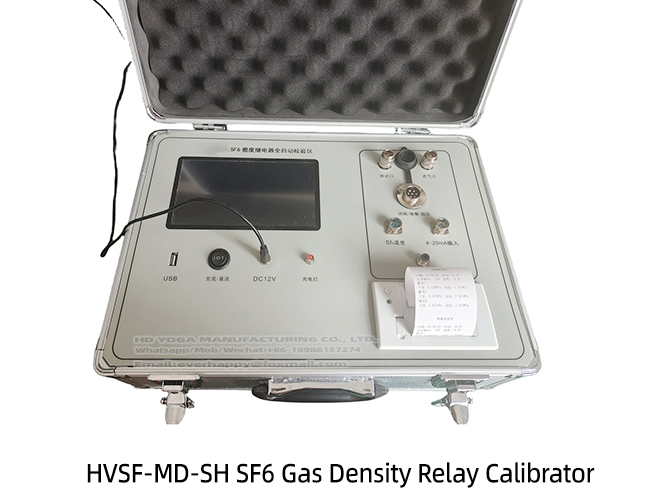
Tech: SF6 Density Relay Calibrator verifies GIS relays for accurate alarm and lockout signals under abnormal conditions
Conclusion: The density relay calibrator is a specialized instrument used to test whether
the relay can accurately issue alarm and lockout signals, ensuring reliable operation when
the gas density is abnormal. For example, a density relay calibrator is needed in GIS
systems for this test.
Click Product Image to Enquire Now
Q1: What is a density relay calibrator?
A density relay is an SF6 gas density relay, a key component installed in equipment such
as GIS systems to monitor the density of internal SF6 gas. The density relay calibrator is a
specialized instrument used to test whether this relay can accurately issue alarm and
lockout signals, ensuring reliable operation when the gas density is abnormal.
Q2: What does an SF56 gas density relay measure?
It is mainly used to monitor the density of SF6 gas inside equipment such as GIS systems.
When a gas leak causes the gas density to drop to a set value, it will issue an alarm or
lockout signal, reminding personnel to handle the situation promptly and prevent
insulation or arc extinguishing problems due to insufficient gas.
Q2.1 - What does arc extinguishing mean?
Arc extinguishing is the process of extinguishing the electric arc generated when a
switchgear disconnects a circuit. When current passes through the disconnected contacts,
a high-temperature arc is formed, which may burn out the contacts or cause a malfunction
. Arc extinguishing uses SF6 gas or similar methods to quickly extinguish the arc, ensuring
a safe circuit disconnection.
Q2.2 - How is arc extinguishing achieved?
In GIS equipment, SF6 gas arc extinguishing relies primarily on its characteristics: When an
arc is generated, the high temperature causes SF6 gas to decompose into highly
electronegative ions. These ions can quickly capture free electrons, reducing the arc's
conductivity. Simultaneously, the structure of the arc extinguishing chamber creates an
airflow, elongating and cooling the arc. Combined with the rapid heat dissipation of SF6
gas, this quickly lowers the arc temperature below its ignition point, thus extinguishing
the arc.
Is an electric arc a type of electrical spark?
Electric arcs and electric sparks are both essentially gas discharge phenomena, but they
are not entirely the same. Electric sparks are typically short-lived and low-energy, such
as the sparks produced when a switch experiences a slight malfunction; while electric
arcs are long-lasting, high-energy, and extremely hot, like the bright arc produced when
a circuit breaker interrupts a large current. It can be said that an electric arc is a more
intense and longer-lasting form of electric spark.
Q3-Why is a density relay needed in GIS, and what is its principle?
Its core function is to monitor the density of SF6 gas, not simply its pressure. Gas pressure
changes with temperature, while density reflects the actual amount of gas. When
equipment leaks, the amount of gas decreases, the density drops, and the relay activates,
hence the name density relay, emphasizing that it measures the key parameter of density.
Q3.1-Why measure density, not gas pressure?
The relationship between gas pressure and temperature: At a given volume, gas pressure
and temperature are usually directly proportional. As temperature increases, molecular
motion becomes more vigorous, and pressure increases; as temperature decreases,
molecular motion weakens, and pressure decreases. This is the relationship described by
Charles's Law. Therefore, simply measuring pressure cannot accurately determine
whether there is a gas leak, while density is not affected by temperature and can truly
reflect the amount of gas.
SF6 密度继电器校验仪用于校验 GIS 设备SF6密度继电器,确保异常时准确发出报警、闭锁信号。
结论: 密度继电器校验仪则是专门用来检测这个继电器是否能准确发出报警、闭锁信号的仪器,确保它在气体密度异常时能可靠工作。例如,GIS中需要用密度继电器校验仪来做这项检测。

Click Product Image to Enquire Now
产品图片
Q1=-密度继电器校验仪是什么东西?
密度继电器就是 SF6 气体密度继电器,它是安装在 GIS 等设备上的关键部件,用来监测内部 SF6 气体的密度。密度继电器校验仪则是专门用来检测这个继电器是否能准确发出报警、闭锁信号的仪器,确保它在气体密度异常时能可靠工作。
Q2-请问 SF56 气体密度继电器,它是测什么东西的?
主要用来监测 GIS 等设备内部 SF6 气体的密度。当气体泄漏导致密度下降到设定值时,它会发出报警或闭锁信号,提醒工作人员及时处理,防止设备因气体不足出现绝缘或灭弧问题。
Q2.1-灭弧是什么意思?
灭弧就是熄灭开关设备断开电路时产生的电弧。当电流通过断开的触头时,会形成高温电弧,可能烧坏触头或引发故障,灭弧就是用 SF6 气体等方式将电弧快速熄灭,保证电路安全断开。
Q2.2-灭弧是怎么实现的?
在 GIS 设备中,SF6 气体灭弧主要靠它的特性:电弧产生时,高温会使 SF6 气体分解成具有强电负性的离子,这些离子能迅速捕捉自由电子,降低电弧导电能力。同时,灭弧室的结构会让气体形成气流,将电弧拉长、冷却,加上 SF6 气体散热快,能快速把电弧温度降到燃点以下,从而熄灭电弧。
电弧,是不是也是电火花的一种?
电弧和电火花本质上都是气体放电现象,但不完全一样。电火花通常持续时间短、能量小,比如开关轻微接触不良时的火花;而电弧持续时间长、能量大,温度极高,像断路器断开大电流时产生的明亮电弧。可以说电弧是更强烈、更持久的电火花形式。
Q3-GIS中为什么需要密度继电器,以及它的原理。
它核心功能是监测 SF6 气体的密度,而不是单纯的气体压力。气体压力会受温度影响变化,密度却能反映气体的实际量。当设备泄漏时,气体量减少,密度下降,继电器就会动作,所以叫密度继电器,突出它测量的是密度这个关键参数。
Q3.1-为什么是测密度,而不是测气体压力?
气体压力与温度的关系:在一定体积下,气体压力和温度通常成正比,温度升高时分子运动变剧烈,压力会上升;温度降低时分子运动减弱,压力会下降。这就是查理定律描述的关系,所以单纯测压力不能准确判断气体是否泄漏,而密度不受温度影响,能真实反映气体量。


everhappy@foxmail.com
+86 18986157274
+8618986157274
1379417129
Copyright ©2018 by HD YOGA MANUFACTURING CO., LTD. Add: No 8 Fty, Canglongdao Dvpt Zone, Jiangxia Dist., Wuhan, Hubei, China. Email: everhappy@foxmail.com

 +8618986157274